
What can we learn from the Fiji Women’s Rights Movement’s work to end workplace sexual harassment?
The Fiji Women’s Rights Movement’s work on workplace sexual harassment offers a clear map of how change actually happens. Not through a single victory or perfect plan, but through decades of strategic choices about when to push, where to apply pressure, and how to respond when power shifts.
This isn’t a story about one campaign or one law. It’s about learning to read the moment, choosing tactics that match it, and building power over time.
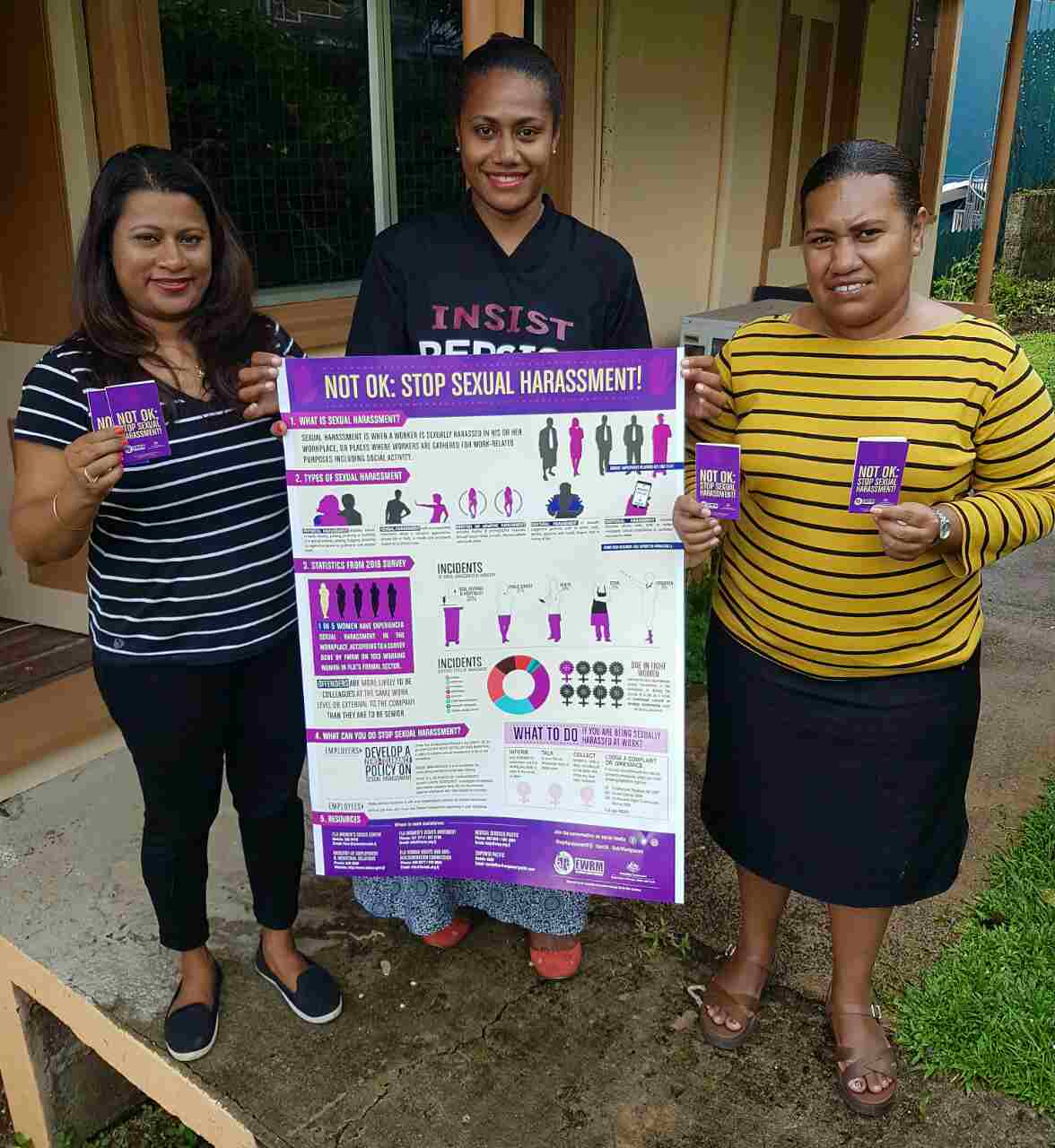
FWRM printed campaign materials such as posters and pamphlets and distributed them to various workplaces in 2017. Image supplied by the Fiji Women’s Rights Movement.
Creating and responding to moments
By the early 1990s, labour law reform was gaining traction globally. Women were entering formal workplaces in larger numbers, but protections lagged behind. Harassment and discrimination were common, often unspoken.
Internationally, the issue of sexual harassment was gaining recognition. In 1992, the CEDAW Committee issued General Recommendation 19, naming sexual harassment as a form of gender-based violence and discrimination that states were obligated to address. Around the same time, the Caribbean Community (CARICOM) drafted a model law on sexual harassment, Costa Rica was moving toward new legislation (passed in 1995), and Japan and India were seeing increased attention to workplace harassment in their courts.
In the U.S., Professor Anita Hill’s 1991 testimony during Clarence Thomas’s Supreme Court confirmation hearings created a moment of global reckoning. Hill’s allegations of workplace sexual harassment, and the scrutiny she endured, put the issue into the public consciousness in a new way. For years, advocacy groups including the National Organization for Women (NOW) had lobbied Congress for robust legislation. Professor Anita Hill’s testimony created a moment. Shortly after the hearings, President George H.W. Bush signed the Civil Rights Act of 1991 into law, reversing his earlier opposition. For the first time, the legislation allowed harassment victims to claim damages and seek jury trials.
Similarly, in India, outrage over the Bhanwari Devi case was building and would soon lead to the landmark Vishaka judgment. Courts in Japan were beginning to frame harassment as a harm. These examples show how political shifts, public outcry, and advocacy efforts converged to create momentum.
In Fiji, FWRM was watching all of this. By 1993, the government had begun outlining a labour reform agenda, and FWRM seized the moment. They launched a project combining research, lobbying, awareness sessions, and media to make sure women workers’ rights were not left out of the picture. Their early advocacy highlighted the sexism embedded in existing labour laws and increased awareness of the need for change.
In 1995, FWRM released a research report titled “Labouring Under the Law” that outlined how current labour legislation disproportionately harmed women. That research helped fuel a national media campaign in 1997, including the TV advertisement “The Boss Wants to See You.” It aimed to define sexual harassment, show how common it was, and highlight the total absence of legal protections at the time.
(Please note: the video features an example of sexual harassment in the form of unwanted touching and implied coercive acts.)
Building momentum through research and pressure
Between 1995 and 1999, global momentum continued. The 1995 Beijing Platform for Action, adopted by 189 governments, clearly named workplace sexual harassment as a human rights issue and called for legislative action. Countries like the Philippines, Belize, South Africa, and India responded by passing legislation, issuing national codes, or releasing binding judicial directives. Still, progress was uneven. Many governments, including Fiji’s, either delayed or adopted watered-down measures.
In 1998, Fiji’s Industrial Relations Bill was released. While it incorporated some of FWRM’s earlier recommendations, it left out any provision on sexual harassment. FWRM responded quickly. In 1999, they published a critique of the bill, highlighting gaps and pushing for the inclusion of provisions requiring employers to address sexual harassment. They also expanded their lobbying strategy, working in coalition with trade unions and other civil society organisations.
Between 2000 and 2005, FWRM kept building. Even in the wake of Fiji’s 2000 coup, they didn’t stop. In 2002, they conducted the country’s first-ever national prevalence study on workplace sexual harassment, and the results made noise. One in three women surveyed reported experiencing sexual harassment in the workplace, often by someone in a position of authority. Most never reported it, citing fear and a lack of mechanisms.
Research on issues that are often ignored or misunderstood is powerful in its own right. It helps both advocates and decision makers understand the problem and can be empowering for those who are experiencing it directly. However, research and data collection can also be resource-intensive and present additional risks, especially on sensitive topics. In the context of gender-based violence, data collection can risk retraumatising survivors or put them at further risk.
The 2002 study became the foundation for a new national campaign: “Stop Sexual Harassment.” The campaign included workshops, print media, interviews, and the development of model workplace policies. Crucially, FWRM used the data not just to raise public awareness, but to lobby policymakers. At the time, Fiji was rewriting its employment and human rights laws. FWRM presented the findings directly to government officials and collaborated with allies in drafting new provisions.
These efforts paid off. By 2003-2004, Fiji’s new Employment Relations Bill included language to prohibit sexual harassment and require workplace policies. These provisions were directly influenced by FWRM’s research and lobbying. In parallel, the government adopted a National Policy on Sexual Harassment in the Workplace, finalised in 2008. It mandated internal complaints procedures for all employers. FWRM contributed to the legislative definition of sexual harassment, helping to ensure it covered both quid pro quo and hostile environment harassment and aligned with international standards.
In 2007, the Employment Relations Act was finally enacted. It included maternity protections, equal pay for equal value, equal opportunity, and penalties for workplace sexual harassment. Many of these reforms were directly tied to FWRM’s recommendations. However, having a law on paper doesn’t mean the problem is solved.
Sometimes the barrier is formal rules and laws. Sometimes it’s about how those laws get enforced. Sometimes it’s more about cultural beliefs and norms. Our advocacy strategies get more effective when we adapt our approach accordingly.
By 2016, a follow-up prevalence study confirmed what FWRM already suspected. Despite the new law, one in five women still reported experiencing workplace sexual harassment. The highest incidence was in the food, beverage, and hospitality sectors. The law existed, but the systems to enforce it were failing. Harmful beliefs persisted, and FWRM adapted their approach in response.
They developed and distributed posters and pamphlets to hotels in the western division, where the problem was most pronounced. They launched a new TV and cinema advertisement. They made submissions to the National Employment Policy, calling for stronger enforcement mechanisms.
At the same time, FWRM partnered with ICAAD and international law firm Manatt Phelps & Phillips to design a regional Train the Trainers program. The aim was to support both workplaces and advocates in creating sexual harassment policies and training staff. That program has since expanded across the region and become a key strategy for implementation.
FWRM also contributed to Fiji’s submission and eventual ratification of ILO Convention 190, which addresses violence and harassment in the world of work. Fiji ratified in June 2020, becoming the first Pacific country and second worldwide to do so.
Making data move people
In 2021, FWRM and its partners launched the Sheila Mannequin Project. The mannequin, named “Sheila” in reference to the common sexist slang term, became a visual social experiment. Women were invited to place a handprint if they had experienced violence. Within two weeks, over 80 women in Ba and Nadi participated, without formal outreach or advertising.
It was a powerful, raw, and expressive form of data collection that also built solidarity in the process. While the 2016 report offered the numbers, the Sheila Project brought them to life.
In 2022 on World Press Freedom Day today, the University of the South Pacific Journalism Programme and FWRM launched a groundbreaking Research Report on the ‘Prevalence and Impact of Sexual Harassment on Female Journalists: A Fiji Case Study” in Suva.
The hope of the research was that the findings will enlighten and create more conversations regarding sexual harassment faced by journalists in the workplace. A panel consisting of senior journalists Lice Movono, Cheerieann Wilson, and the-then femLINKpacific Executive Director, Susan Grey discussed key findings of the report and shared their experiences while working in mainstream media.
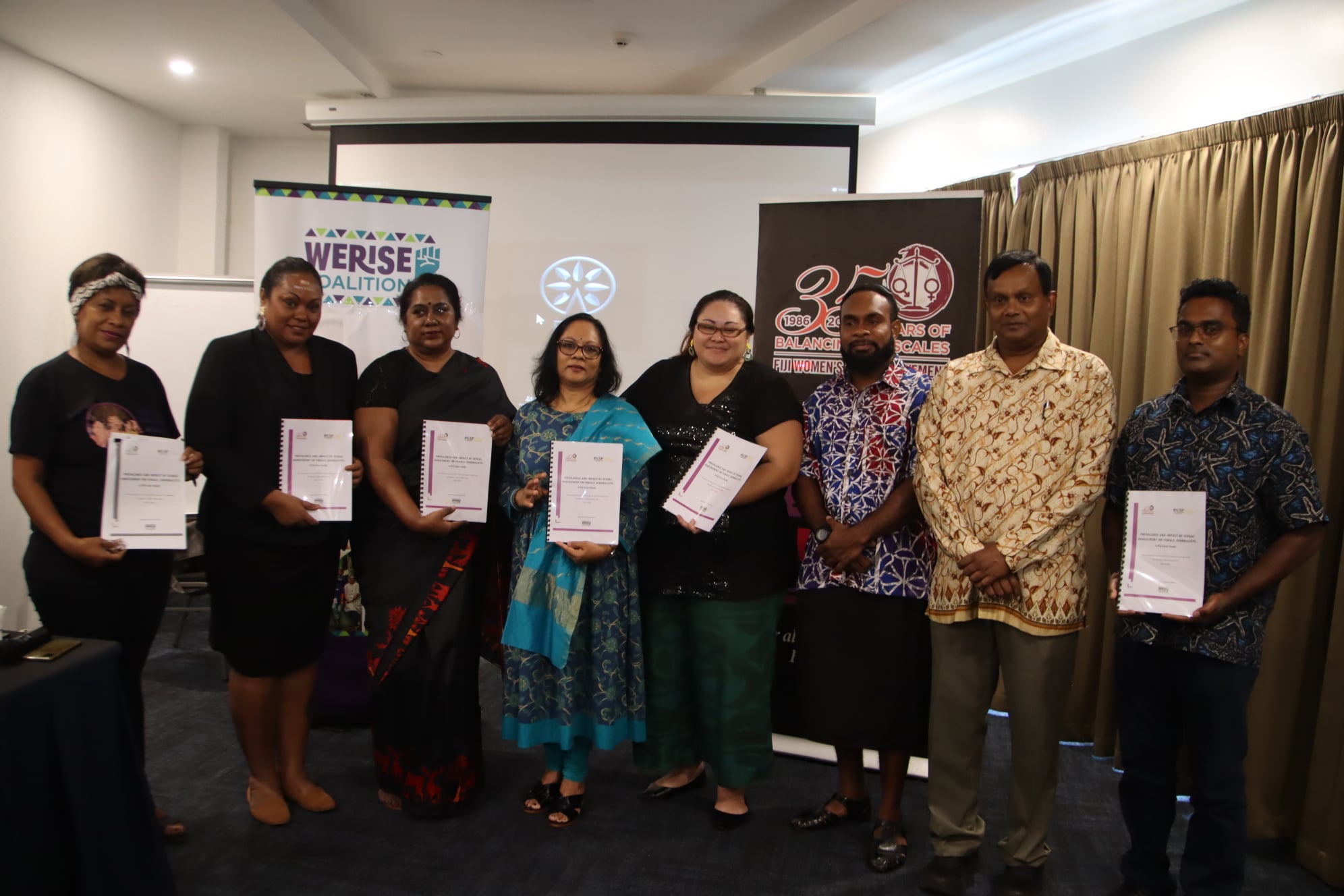
In 2022, FWRM and the University of the South Pacific published a study on sexual harassment of female journalists in Fiji. Image supplied by the Fiji Women’s Rights Movement.
Strategic decisions
FWRM didn’t just build a strategy based on what was available. They made decisions based on who they were trying to move, what kind of resistance they were facing, and what kind of moment they were in.
When sexual harassment wasn’t recognised as a legal issue, they started with research and institutional advocacy. As they learned more about the barriers, they escalated their approach, moving from private meetings to public awareness, from internal advocacy to broader coalition-building and media pressure.
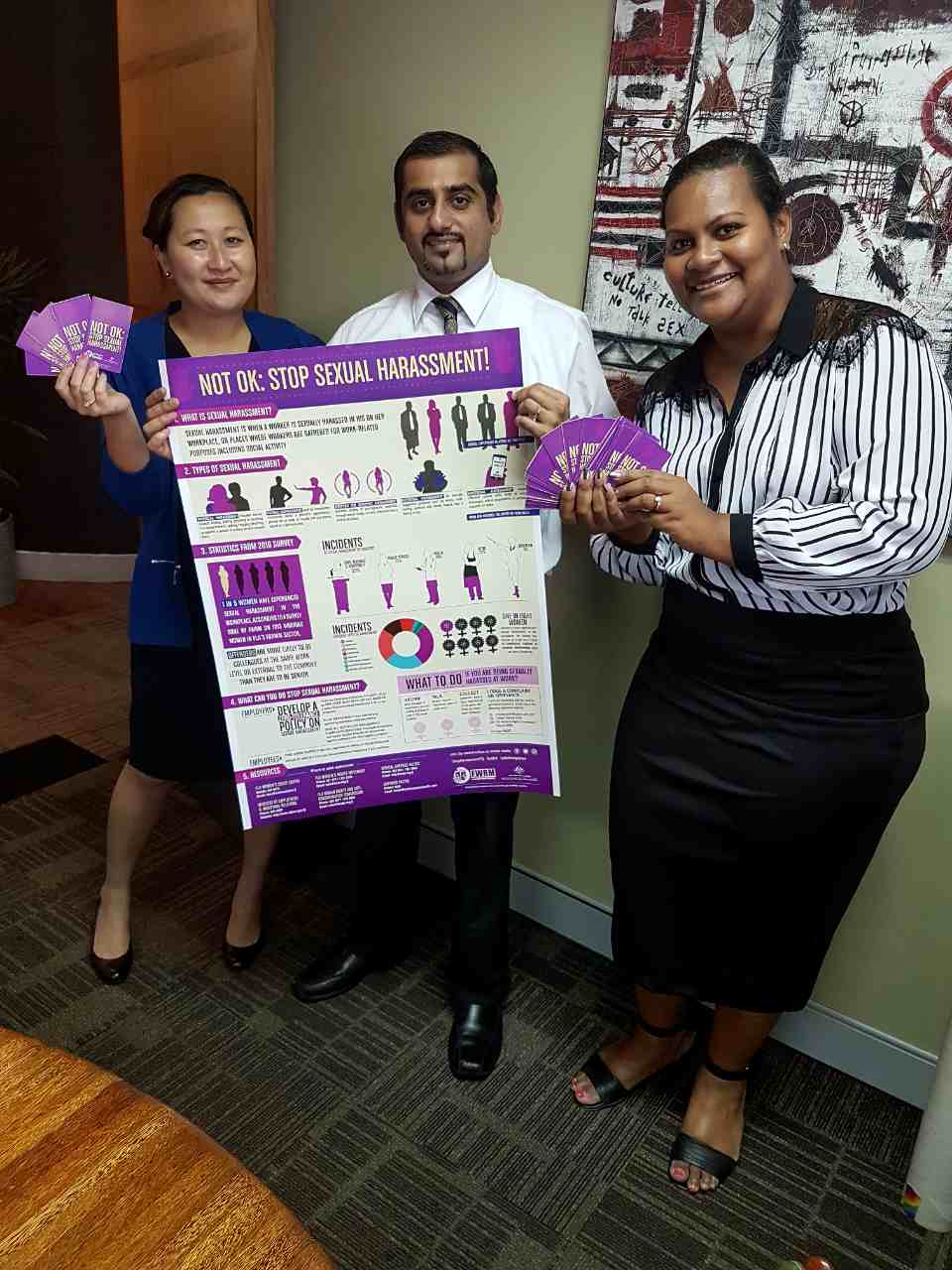
FWRM printed campaign materials such as posters and pamphlets to distribute to workplaces in 2017. Image supplied by the Fiji Women’s Rights Movement.
Effective strategies escalate as needed, often starting small with a report or a lobbying meeting and escalating to determine how much power is needed to influence key targets. For FWRM, the first research report helped define the problem. The 2002 prevalence study backed up their policy demands. Consistent lobbying and awareness kept the issue on the table and helped them build power over time, even through tumultuous political moments.
Even after winning the legislation, they pivoted to ensure it would be enforced. The 2016 study pushed enforcement back onto the agenda. The Sheila Project reached people emotionally and visually, in a way reports couldn’t. The research and data collection they employed all had a purpose, depending on what kind of shift they were trying to make and who they needed to move.
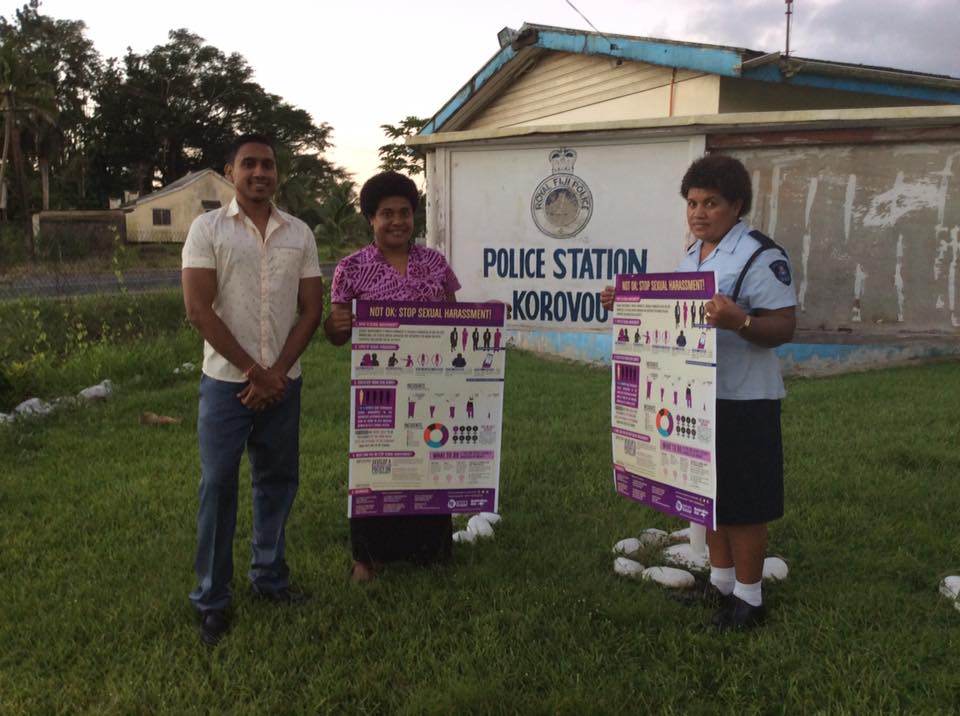
Posters were distributed around various workplaces in the western division as part of the campaign against sexual harassment in the workplace in 2017. Image supplied by the Fiji Women’s Rights Movement.
What this teaches us about change
As a case study full of lessons, FWRM’s strategy in Fiji shows how advocates create and respond to moments not only by identifying windows of opportunity, but by shaping them through research, storytelling, pressure, and persistence. It also shows how data, when used well, becomes a core part of the strategy. It’s not just about understanding a problem. It’s about collecting and sharing information that moves the people who need to be moved.
FWRM used different approaches for different purposes. They adapted based on who they needed to influence and what kind of resistance they were facing. They paid attention to the specific barriers at play and aligned their actions accordingly. They didn’t stick to a single type of tactic, but moved between them to escalate and meet each moment.
Effective strategy is less about having the perfect plan and more about staying responsive to power, to the moment, and to the people you’re trying to move. FWRM’s work reminds us that advocacy is not just about what tactics we use. It’s about when, how, and why we use them. Tactics are tools. The skill is learning how to use them well.
To hear more about FWRM’s work and their latest campaigns, follow them on social media here:
Keen to learn more about advocacy strategy? This blog post draws on the frameworks offered in ICAAD’s Advocacy Academy, developed to support advocates working to dismantle structural discrimination and build power for systemic change. Learn more and join the waitlist for the next course offering.