Governments continue to apologise for their algorithmic scandals, and civil society are the ones documenting the missteps for us to learn the right lessons. This is how the Global Dialogues on AI Governance made the case for funding that capacity properly.
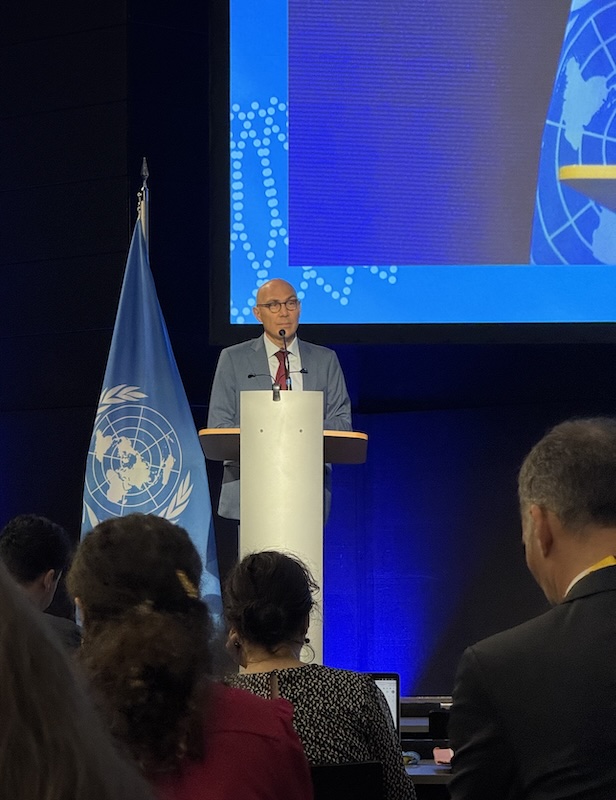
“Human oversight of AI systems cannot be just a rubber stamp. It requires that an identified person be granted authority, competence, time, independence and power to alter and even stop a system.”
– UN High Commissioner on Human Rights, Volker Türk
The first UN Global Dialogue on AI Governance met in Geneva on 6 and 7 July. It drew more than 4,200 participants from nearly 170 member states, and it closed without a negotiated outcome document. Closing the event, co-chair Rein Tammsaar of Estonia stated the reason: the world’s challenge is no longer a lack of AI principles, but the absence of practical mechanisms to implement them. This is a roadmap for what funders should focus on.
Start with what the Independent International Scientific Panel on AI put in front of member states. Its preliminary report, drawn from 40 experts across all five UN regions, points out two very important things among many. AI systems produce confident errors. They generate answers that are plausible and wrong, and they cannot tell the difference.
At the same time, people over-trust machines, because computing has delivered so much that is genuinely reliable. Put those together inside an institution with the power to garnish wages, remove children, or track a car across state lines, and the result is not hypothetical.
Three shocking cases show what that looks like in practice:
Australia’s Robodebt scheme used income averaging to auto-generate welfare debt notices, comparing annual tax records against fortnightly welfare payments. The method invented debts for anyone with irregular earnings. Around 440,000 to 500,000 people were pursued, and roughly A$1.76 billion in unlawful debts were raised against some 433,000 individuals, among the poorest people in the country. Internal legal advice said the scheme did not accord with the legislation in November 2014, before it launched. It launched in July 2015 anyway. Even after further advice in August 2018 again found it unlawful, it ran until November 2019.
In the Netherlands, the tax authority ran a self-learning risk classifier that flagged childcare benefit claimants as likely fraudsters and demanded full repayment. It disproportionately targeted families with dual nationality and ethnic minority backgrounds. Around 26,000 families were wrongly accused. Thousands of children were removed from their homes, and the government is still dealing with the fallout of the scandal and thousands of parents are still uncompensated.
In the United States, Flock Safety’s automated licence plate readers have been installed in over 6,000 communities, building a searchable national record of where vehicles have been. Audit logs reviewed by journalists showed local police running searches on behalf of federal immigration authorities, including more than 4,000 lookups traced through the records of a single Illinois department. A Washington Post investigation identified at least 50 officers charged with or accused of accessing the data for personal reasons, most often to track women they had been in relationships with. In June 2026, officers’ logged search reasons, and in some cases the plates they searched, were found to have been indexed by public search engines. Since the scandal broke, at least 53 cities across 20 states have cancelled contracts and some officers have been dismissed.
Let’s look at how each of these came to light.
Robodebt did not stop because the government caught its own error. Five years of internal legal advice failed to stop it. It ended after Victoria Legal Aid brought a legal challenge that forced solicitor-general advice confirming the scheme was unlawful, with Gordon Legal’s class action securing redress afterwards. The Dutch scandal surfaced through journalists, lawyers, and the affected parents themselves. The Flock disclosures came from investigative newsrooms and a local privacy coalition in Colorado working through public records.
Civil society documented every one of these. In effect, civil society was the accountability system.
This is not an argument against justice-tech or AI. With support from the Patrick J. McGovern Foundation, ICAAD is automating parts of our analysis of judicial bias in domestic and sexual violence cases through ImpartialAI, built on the gold-standard dataset behind TrackGBV and validated against expert manual coding. The direction of that work is the whole point, demonstrating use cases in which AI can help monitor and analyse human decisions for further learning and development, not replace the human who decides.
The Global Dialogue on AI Governance made it clear where the pressure needs to go. As Jaspreet Singh, Co-Founder of ICAAD, told Devex during the Dialogue, the Scientific Panel’s report warns that AI capability is concentrated in a handful of firms, the very same firms whose lobbying shapes the rules meant to govern them, and whose contracts governments depend on. Regulators cannot be the only check on companies they are entangled with. Yet we ask groups running on the smallest budgets to watch systems built with trillions. Investing in civil society’s capacity to monitor, litigate, and remedy, especially in the global South, is critical accountability infrastructure in addition to a strong regulatory framework.
Others made versions of this argument in the room. Zach Lampell of the International Center for Not-for-Profit Law (ICNL) called for a guaranteed right to remedy, so that people can contest and correct harmful AI-assisted decisions and a clearly accountable actor remains within the decision-making process. Luísa Franco Machado of EquiLabs pressed delegates on why many at the dialogue were focused on governing young people’s relationship with technology rather than technology companies’ relationship with power.
The convergence of these ideas is what the evidence supports. ICAAD is building a rights-based human rights due diligence tool with our legal partners, free to civil society. There are many civil society efforts like ours that need investment.
The second Global Dialogue meets in New York on 3 and 4 May 2027. A written submission portal opens ahead of each session, and the first round drew more than 1,500 inputs. Transparency, accountability, and human oversight ranked among the highest priorities in that round. The evidence and the testimonies are clear. The question between now and New York is whether governments and funders build the mechanisms to act on them, and whether they will resource the organisations that have been doing this work without them.