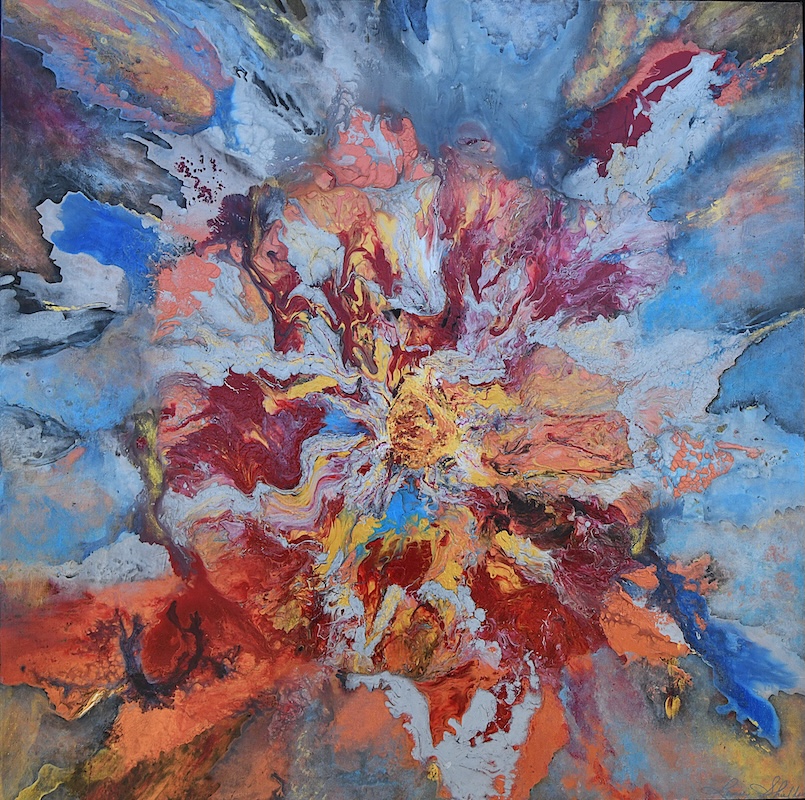
Louise Shields, Flor Estrella Star Flower
The Bolivia Moon Agreement is a student-governed legal and cultural reworking of the 1979 Agreement Governing the Activities of States on the Moon and Other Celestial Bodies. Using the Moon Agreement’s treaty architecture as a legal frame to scaffold the students’ insights, it translates selected parts of that architecture through the concepts, tensions, and governance imagination produced by students during the April 2026 LunARC Lab at Universidad Nur in Santa Cruz, Bolivia . By intentionally choosing an international instrument which has been ratified by few countries, several which are from the Global South, we can build on an existing legal framework which has not hardened into customary international law. This does not however reflect an initiative to revive or amend the Moon Agreement as such.
The Lab brought together students from law, medicine, engineering, tourism, psychology, international relations, among other fields. Over three days, participants moved through personal reflections on the Moon, collective governance exercises, and the development of a final message intended for the Moon. The Lab’s outputs include documentation of student motivations, whole-group discussions, team maps, design guidelines, governance model presentations, individual and collective guardrail responses, reflective questionnaires, online governance games, facilitator interpretive notes, and a LunARC payload text intended for future delivery to the Moon.
In reimagining the original Moon Agreement, this document treats the Lab record as a form of student-generated travaux préparatoires: an interpretive record of how ideas emerged, were challenged, and were refined through collective deliberation. The Bolivia Moon Agreement’s text balances original treaty language with student ideas that have been translated into a legal architecture based on the Moon Agreement. The commentary preserves tensions, reasoning, and interpretive context that provide additional depth to the ideas reflected in the treaty text. The annex allows readers to trace treaty clauses and commentary claims to three source layers: Lab evidence, the original Moon Agreement, and selected travaux préparatoires from the original treaty negotiations. The original Moon Agreement travaux are brought into the document only where they illuminate or parallel conversations that emerged during the Lab; this document is not intended to be a complete examination of the Moon Agreement’s negotiating history, rather it aims to shed light into areas of prior deliberation that the students have contributed fresh ideas to.
The Bolivia Moon Agreement also applies a Bolivia Voice Integration method. Spanish, Indigenous, and locally grounded concepts are preserved where they do legal or governance work. Terms such as Suma Qamaña, Equilibrio, Cosmovisión, Comunidad, Bien común lunar, Líder sabio, and nosotros decidimos are vital to understanding the students’ vision. Where these concepts first appear, they are succinctly defined. Deeper cultural and legal interpretation then appears in the commentary.
Each Lab team named both its governance model and itself. The commentary refers to the teams by the names they chose: Team Interestelar (model: Sistema Internacional), Team Terranova (model: Monitoreo Sostenible), Team La Tierra Prometida (model: Comunidad), and Team Madre Luna (model: Equilibrio).
This document shows how a participatory Lab can be translated into a legally intelligible framework while preserving authorship, local meaning, and traceability. In this sense, the Bolivia Moon Agreement places the students in conversation with the States that negotiated the original Moon Agreement, asking where their ideas align, where they deepen existing law, and where they challenge the assumptions of state-centered space governance.
The conclusions and recommendations reflected in the following document do not necessarily reflect positions or opinions held by Nur University, LunARC, or ICAAD. These are products of the students involved in the Lab, manifestations of their worldviews and ideals.
Read the agreement below. También disponible en español.