Horizon Scanning
Anticipating tomorrow’s human rights challenges before they arrive.
Human rights organizations tend to be reactive. A crisis emerges, communities are harmed, and advocates mobilize to respond. But some of the most consequential threats to equity and justice are taking shape right now.
ICAAD was founded with an orientation toward the future. Horizon Scanning is where we do our most forward-looking work, applying the same rigorous, rights-based analysis to emerging domains where the rules have not yet been written.
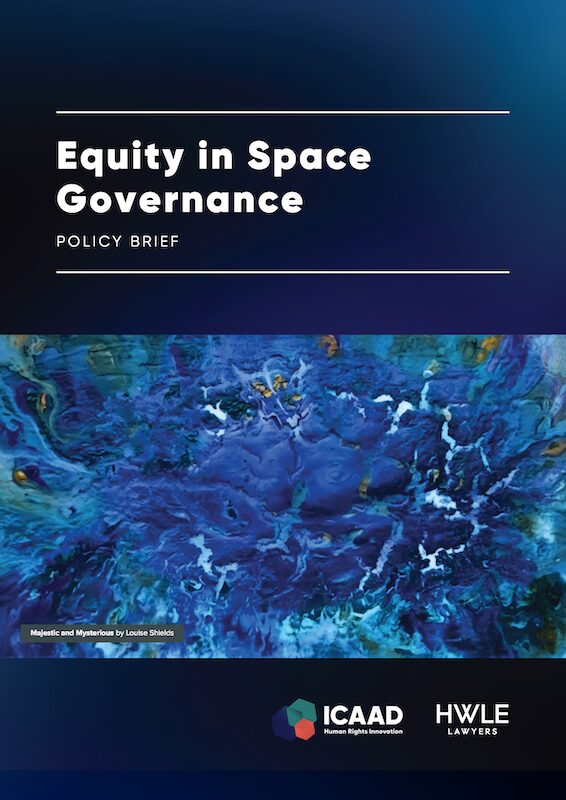
Outer Space Governance
Who Gets to Shape the Rules Beyond Earth?
As humanity expands into space, the legal decisions made today will determine whether the mistakes of colonial extraction are repeated beyond our atmosphere. Property rights are being created that contradict the foundational principle that space is “the province of all mankind.”
Artemis Accords vs Equity
ICAAD’s analysis identifies a core tension: while previous treaties sought shared human ambition, current trajectories risk replicating extractive dynamics. Without rooting out coloniality, space exploration becomes space exploitation.

Terrestrial Analogs
From the Deep Sea to the Stars
The governance of the deep sea is particularly instructive. When “dark oxygen” was discovered in the central Pacific, it triggered a call by over 40 countries for a precautionary pause on mining. This is what responsible governance should look like: prioritizing the protection of the commons over a rush to extract.
ICAAD’s research draws direct parallels between how we govern the deep seabed and outer space, and seeks to ensure that those historically excluded from these decisions finally have a voice.
A Pattern of Being Early
ICAAD’s established programs grew from experiments and early bets on questions the rest of the field had not yet taken up.
SMS for Justice, India
One of the earliest examples of using mobile tech for community-led accountability. Coded SMS messages allowed local paralegals to map healthcare gaps, leading to substantive reforms.
Machine Learning Experiments
Before AI was a buzzword, ICAAD was experimenting with ML to scale case law analysis. While the tech wasn't ready then, it provided the foundation for our gold-standard dataset and today's ImpartialAI.
Toronto Declaration
ICAAD was an early signatory on ML and human rights, dedicating internal resources to AI governance long before the launch of our Inclusive AI program.
The Rules Are Being Written Now
ICAAD works to ensure that communities most affected by systemic inequity have a voice in the decisions that will shape human rights for generations.
From Our Archive
H.uman Rights Data
TrackSDGs
Algorithm linking 57,000+ UPR recommendations to the SDGs
Tech Pilot
Machine Learning (2016)
Early case law analysis experiments.
Governance
Toronto Declaration
Early engagement on AI accountability.
Health Justice
SMS for Justice
Mobile tech mapping healthcare gaps in India.
Participatory Design
VR for Bias Reduction
Using immersive tech to promote empathy.
Rights Protection
Protecting Asylees
Research on refugee and asylum frameworks.