
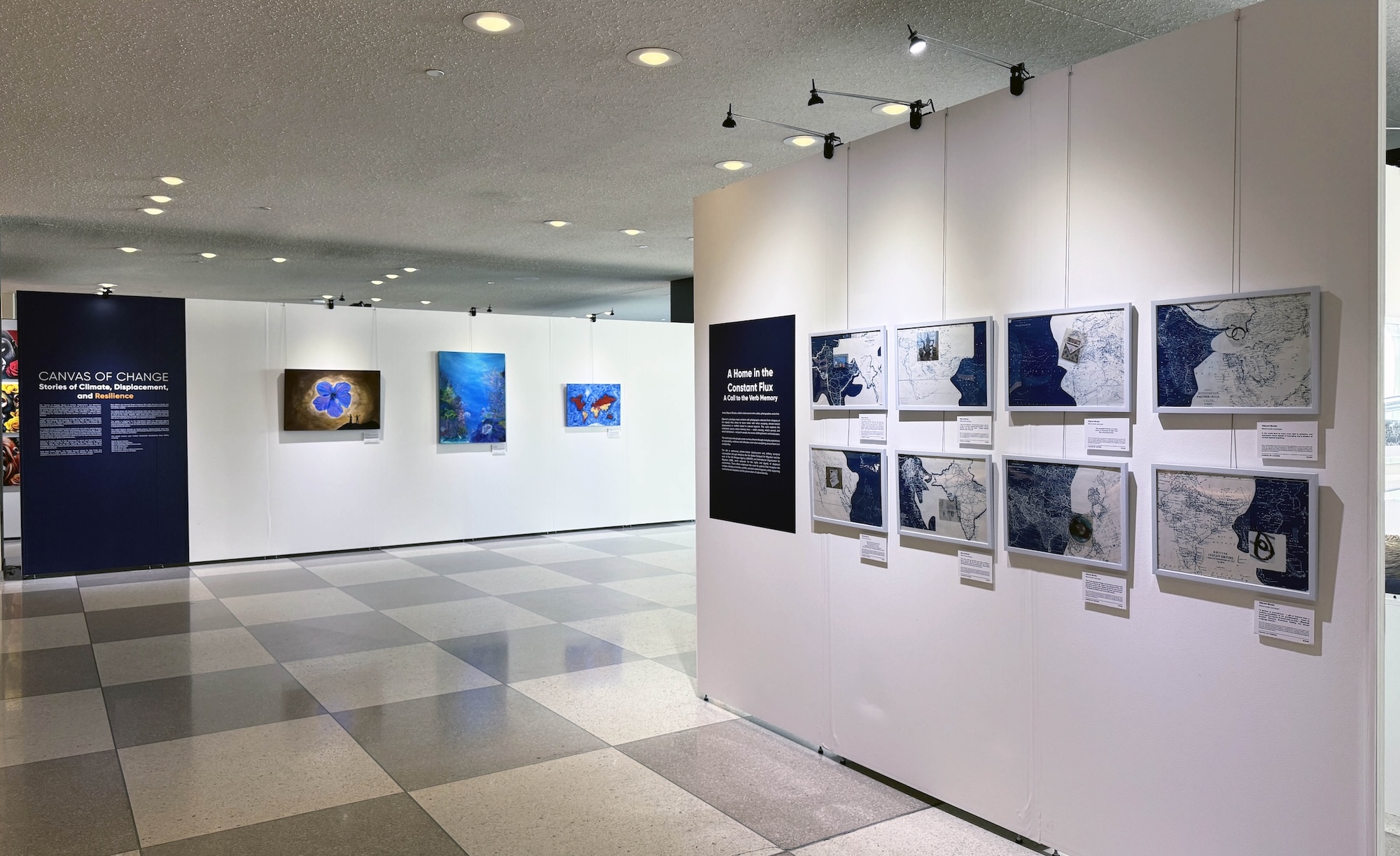
Canvas of Change, Main Lobby Gallery, UN Headquarters, New York, 2026.
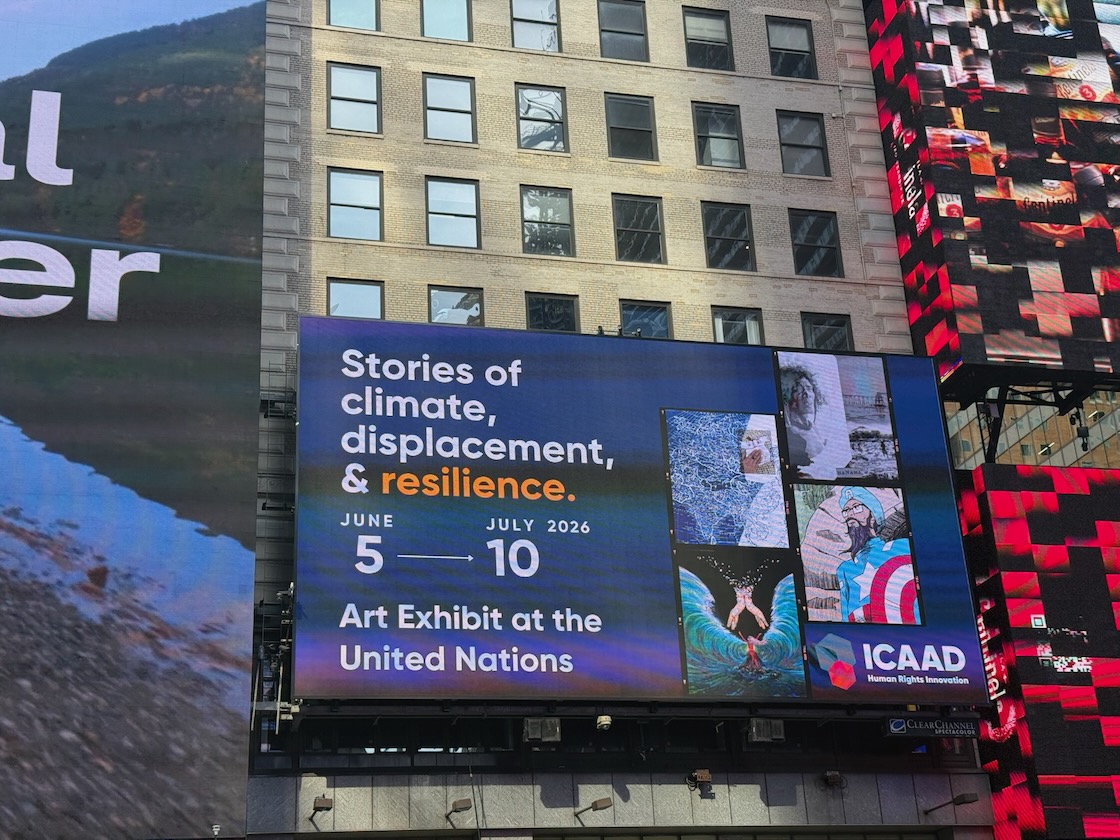
From June 5 to July 10, 2026, the Main Lobby Gallery at United Nations Headquarters in New York held Canvas of Change: Stories of Climate, Displacement, and Resilience, organized by ICAAD and endorsed by UN Women. Every day the exhibit was open, delegates, UN staff, and visitors walked through it, and it was on during COSP19, the Conference of States Parties to the Convention on the Rights of Persons with Disabilities, and during the High-Level Political Forum. People were taking pictures with the artwork, watching and contemplating, and discussing what they were seeing with others. An estimated 5,000 visitors engaged with the work, drawn from the more than 50,000 people who passed through the Visitors’ Lobby during the exhibition’s 26 open days.
Every work came out of ICAAD’s Artivist-in-Residence program. The exhibit explored the origins of the climate crisis, migration and borders, the costs of forced displacement and the work to reconcile while being resilient, and finally to the inner work that sustains advocacy.
Watch: Canvas of Change Gallery Walkthrough and Artivist Talks
The Artwork in Four Movements
Colonialism and the Climate Crisis. Seven paintings by Namita Kulkarni, a yoga teacher, writer, and artist based in Mysore, on over-extraction and Indigenous sustainable practice. In Colonizer Crisis, gold leaf marks the regions of the Global South that bore the weight of colonial resource extraction. Bon Appétit fills a plate with glaciers, forests, mountains, and oceans. Woman Stands Shining draws on Pat McCabe, the Diné activist, writer, and ceremonial leader, and her familial relationship with water. Lakes on Fire is about Bangalore, where trash and sewage on the lake surfaces have caught fire several times in the last decade.
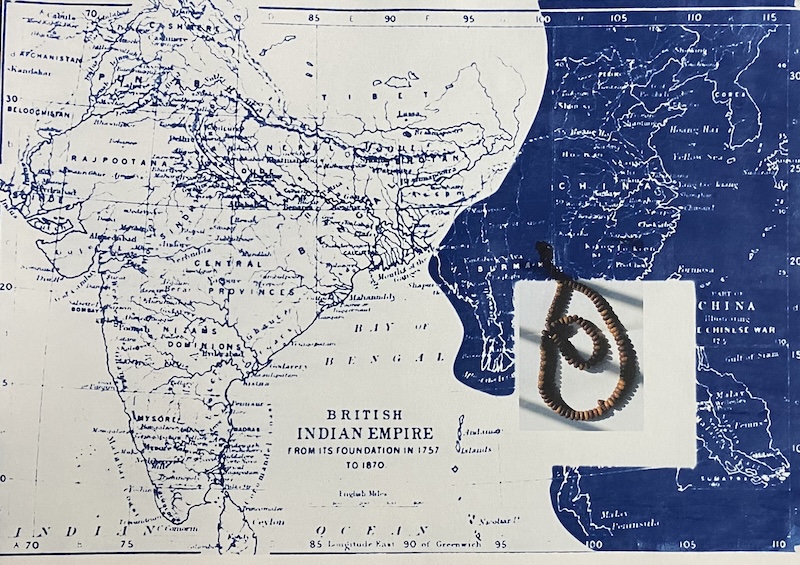
A Home in the Constant Flux: A Call to the Verb Memory. As Dilpreet Bhullar describes her series, “In the world bent to erase one’s right to existence and expression, these objects of belonging cast a shadow of survival against forgetting.” Eight mixed-media cyanotypes by Dilpreet, a writer, editor, photographer, and artist in Delhi, combining colonial-era maps with photographs collected from refugees of the objects they chose to leave home with. Each label carried a line of poetry or thought from a different displaced or postcolonial voice: Chinua Achebe of Nigeria, Eugenio Montejo of Venezuela, Kama Sywor Kamanda of Congo, Al-Saddiq Al-Raddi of Sudan. Beside a photograph of prayer beads, Somali poet Hadraawi: a gift of Tasbeeh from a maternal grandfather to her granddaughter, return to home with the warmth of beads after an exile. Together the eight made a chorus across four continents of the same displacement.
Justice for Rabi. A mixed-media series by Katja Phutaraksa Neef, winner of Amnesty International’s Gary Ware Legacy Award; Vaitoa Teaiwa Mallon, a Banaban student at the University of Auckland; and Takuaroroa Teribabati, a Banaban Elder, dancer, and artist, whose traditional woven fiber and shell dance attire, created on behalf of her son Kuta Joseph Fonorito, anchored the installation. Katja’s Their Ashes Are On the Land We Live On is oil painted directly onto a colonial tapestry, putting Banaban figures back onto the decorative surface of empire. Vaitoa’s three Ocean Island Untitled works recombine photographs taken by Albert Ellis, the 20th-century phosphate prospector whose arrival began the mining, contrasting Banaban people against the motifs of the colonial enterprise that displaced them.
American Sikh and re:covering. Ryan Westra and Vishavjit Singh’s Webby-winning animated short screened on a single monitor with headphones: the true story of an American-born, turban-wearing Sikh man who, after a lifetime of prejudice, self-doubt, and violence, finds acceptance in a superhero costume. A story of belonging. Alongside it, seven digital assemblages from Queen’s re:covering (The Reflection Sessions), made in response to the reflections of five international human rights advocates and a psychologist who assists activists. Their premise is one every person should sit with: the systems of oppression that function institutionally also function through us, and without a practice of re:flexing we risk reproducing them inside the movements we build.
Why Justice for Rabi?
In 1897, a geologist, Albert Ellis, noticed that a rock from Nauru propping open a door in a Sydney office was rich in phosphate. Three years later, he arrived on Banaba and began mining. Over the following eight decades the British Phosphate Commission, jointly owned by the British, Australian, and New Zealand governments, stripped 90 percent of Banaba’s surface and removed 22 million tons of land, cutting the island from 80 meters above sea level down to 20 or 30.
In 1942 those same three governments bought Rabi Island in Fiji, more than 700 miles away, to relocate the Banaba people. On December 6, 1945, a thousand Banabans left Tarawa aboard the MV Triona, arriving in Rabi on December 15th.
The UN Charter had entered into force fifty-two days earlier.
The claim has never been abandoned, and Justice for Rabi has become part of how it travels. The series was first exhibited in 2023 at Silo 6 on the Auckland waterfront, co-funded by the New Zealand National Commission for UNESCO with support from Creative NZ, the Taiwan Foundation for Democracy, and Amnesty International. Auckland mattered because New Zealand co-owned the Commission. One visitor wrote in the comment book that before the exhibition they had not known of New Zealand’s involvement in the mining, or that its agricultural industry had thrived on it.
That show got a government interested, and it opened a sequence. In 2024, ICAAD joined its long-time partners at the Banaban Human Rights Defenders Network in Geneva ahead of Fiji’s Universal Periodic Review, submitting a joint report on protection for human rights defenders on Rabi, restoration of democratic governance through elections to the Rabi Council of Leaders, and an end to structural discrimination against ethnic minorities. The recommendations landed. On May 28, 2026, eight days before Canvas of Change opened in New York, Fiji passed the Citizenship of Fiji (Amendment) Bill 2026, legislating a promise the government had made to Banabans and answering concerns ICAAD and BHRDN had documented in the Banaban Citizenship Handbook. The law simplifies naturalisation, no longer routes applications through the Rabi Council of Leaders, defunct for more than 13 years, and for its first five years waives the application fee for Banabans living in Fiji. Those fees had been the largest barrier to Banaban citizenship.
“So art opened the door and policy change happened. We move people in this way. We always have as community, and we can keep doing that.” – Jaspreet K. Singh, ICAAD Co-Founder
The artist talks
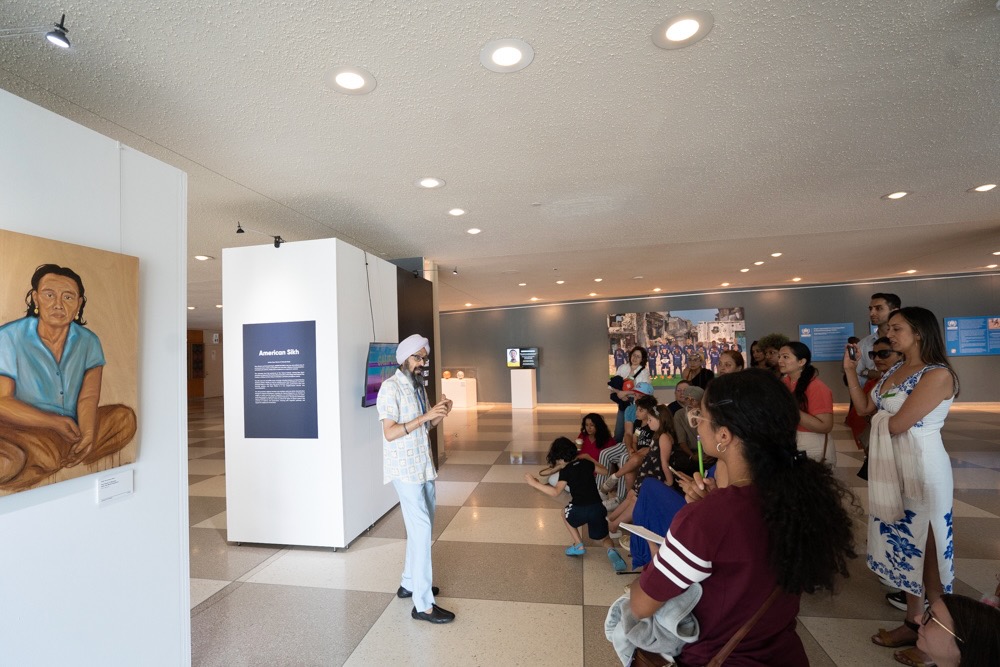
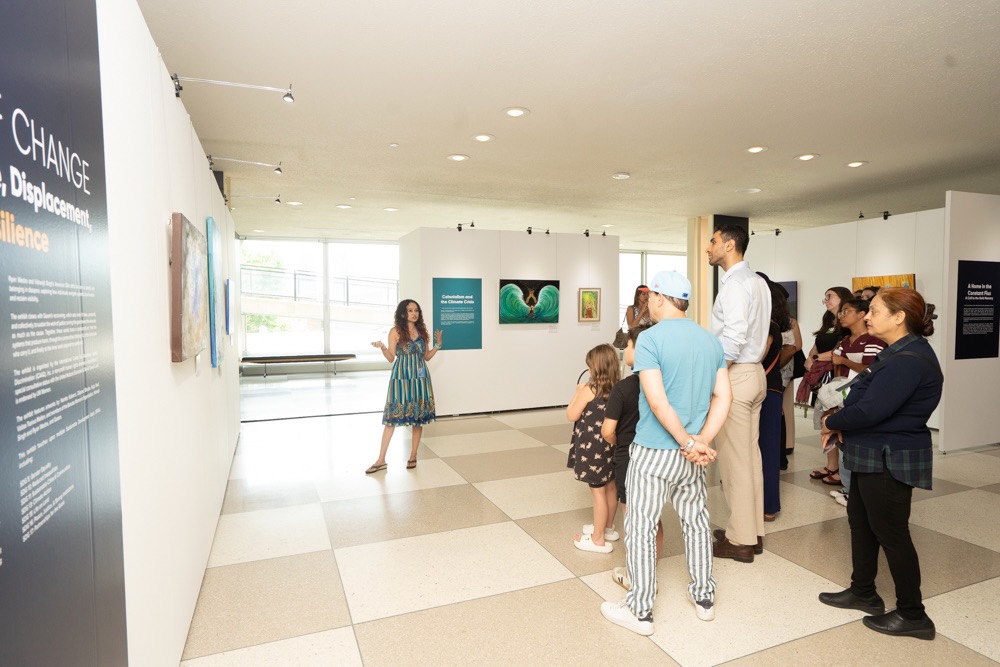
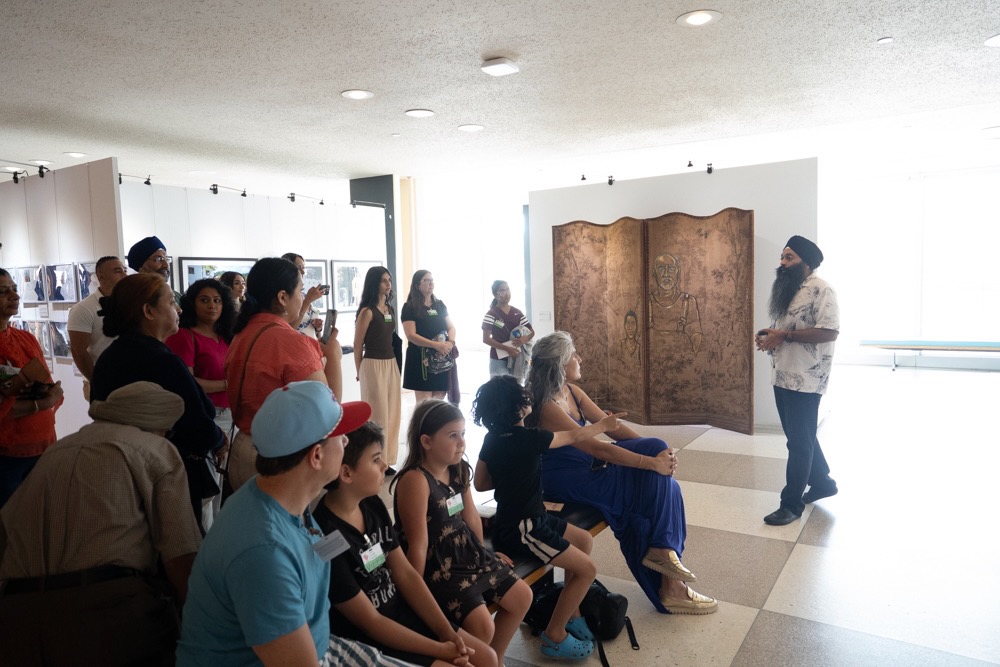
Four times during the run, visitors were able to interact with two of the artists: Namita Kulkarni, who came in from Bangalore, and NYC-local Vishavjit Singh.
ICAAD co-founder Jaspreet K. Singh opened the first three, each beginning with a walkthrough of the gallery and a word on how the Artivism program opens people to alternative ways of thinking and being while also opening the door to direct policy change. On June 11, Namita led visitors through the seven paintings making the case that the climate crisis has a history and that the history has beneficiaries. She returned on June 12, joined by Vishavjit. On June 19, the two presented together again, walking the group through the four movements before turning to American Sikh and Vishavjit’s own road from being a target to being visible on his own terms.
The fourth came on July 7, when a team from Manatt, Phelps & Phillips, a law firm that has partnered with and supported ICAAD for almost a decade, visited. ICAAD co-founder Hansdeep Singh led them through the exhibit and explained the Artivism program behind the work, and Vishavjit told his story.
Art as evidence
ICAAD builds evidence before it advocates, and often that evidence takes the form of a dashboard, a shadow report, a policy brief. A tapestry of empire painted over with the faces of the displaced, a prospector’s photographs turned against the industry that commissioned them, a length of woven shell: this is evidence too, and it travels on its own terms.
Our thanks to Namita Kulkarni, Dilpreet Bhullar, Vishavjit Singh, Ryan Westra, Queen, Katja Phutaraksa Neef, Vaitoa Teaiwa Mallon, Takuaroroa Teribabati, and the members of the Banaba Women’s Organization, for trusting ICAAD with their work and their communities’ stories. To the Banaban Human Rights Defenders Network. To UN Women for its endorsement, and to the UN Exhibits Programme.
Explore the work of ICAAD’s Artivists-in-Residence.
Support the next residency. ICAAD’s Artivist-in-Residence program pairs artists with communities pursuing justice claims and carries the resulting work into the rooms where decisions get made. If you would like to sponsor a residency or host the exhibition, we would love to hear from you.